Configuration
Contents
Global configuration
Configure Booster by adding a configuration file to your XP instance.
XP_HOME/config/com.enonic.app.booster.cfg
cacheTtl = 3600
cacheSize = 10000
appsForceInvalidateOnInstall =
excludeQueryParams =
disableCacheStatusHeader = false
cacheMimeTypes = text/html, text/xhtml
overrideHeaders =- cacheTtl
-
Default time-to-live (TTL) for the cache is seconds. The default value is 3600 seconds (1 hour).
- cacheSize
-
Total number of items in the cache. The default value is 10000.
- appsForceInvalidateOnInstall
-
Comma-separated list of applications that should invalidate the cache on their installation. By default, no applications are listed.
- excludeQueryParams
-
Comma-separated list of query parameters that should be excluded from the cache key. Allows to add extra query parameters to exclude from the cache key without need to change default. A token prefixed with
-removes the given parameter from the preset (e.g.-ciddropscidfrom the effective list). By default, no extra query parameters are listed. - excludeQueryParamsPreset
-
This comma-separated list contains "preset" of query parameters that will not be affected by changing
excludeQueryParams. More details about this below: - disableCacheStatusHeader
-
If set to
trueCache-Statusheader is not sent in the response. The default value isfalse. - cacheMimeTypes
-
Comma-separated list of MIME types that should be cached. The default value is
text/html, text/xhtml. - overrideHeaders
-
Comma-separated list of instructions that override headers. By default, no instructions are listed. Use with causion.
Query Parameters
Booster considers query parameters when generating the cache key. However, some query parameters are not relevant, and should be excluded for a better performing cache. Examples of such are marketing and ads related parameters, where the rendered result will look the same regardlessly.
excludeQueryParamsPreset contains a list query parameters that should be excluded from the cache key. The default preset is sourced from mpchadwick/tracking-query-params-registry plus 5 HubSpot parameters (_hsenc, hssc, hstc, __hsfp, hsCtaTracking) that are not part of that registry. The registry is not included as a dependency, but the preset is maintained by Enonic team and updated periodically.
If you want to keep the default list and add extra query parameters to exclude from the cache key, you can use the excludeQueryParams configuration property. Prefixing a parameter with - in excludeQueryParams removes it from the preset — for example, if your site uses ?cid= legitimately:
excludeQueryParams = -cid, my_custom_paramTo override the presets entirely, simply add your own version of excludeQueryParamsPreset in the configuration file. The - prefix is only honored in excludeQueryParams, not in excludeQueryParamsPreset.
If page rendering varies on any of the excluded parameters, make sure that Booster application does not cache the response, for instance by having Cache-Control: private header in the controller’s response. |
MIME Types
Booster caches text/html and text/xhtml MIME types by default. The cacheMimeTypes configuration property is a comma-separated list of MIME types that should be cached.
Allow caching of text/plain (such as robots.txt), text/xml (such as sitemap.xml) and application/manifest+json (manifest.json) MIME types:
cacheMimeTypes=text/html, text/xhtml, text/plain, text/xml, application/manifest+jsonBooster does not cache responses with Vary header, including but not limited to Vary: Accept. |
Control downstream cache
Different CDN and proxy servers can cache the response. Booster can help to control the downstream cache by using overrideHeaders configuration property allows to override response headers. The property is a comma-separated list of instructions that override headers. Each instruction is a key-value pair separated by a colon. The key is the header name and the value is the header value. The header value can contain placeholders that are replaced with the actual value from the original response.
Disable caching in the downstream cache (CDN and browser):
overrideHeaders="Cache-Control: private, no-store"Disable cache in Fastly CDN but leave browser caching instruction as is:
overrideHeaders="Surrogate-Control: private"Disable cache in Cloudflare CDN but leave browser caching instruction as is:
overrideHeaders="Cloudflare-CDN-Cache-Control: private"Allow Fastly CDN to cache the response for 24 hours, but browser should cache the response for 1 minute:
overrideHeaders="Surrogate-Control: max-age=86400","Cache-Control: max-age=60"Site configuration
When adding Booster to a site, it may be tuned specifically
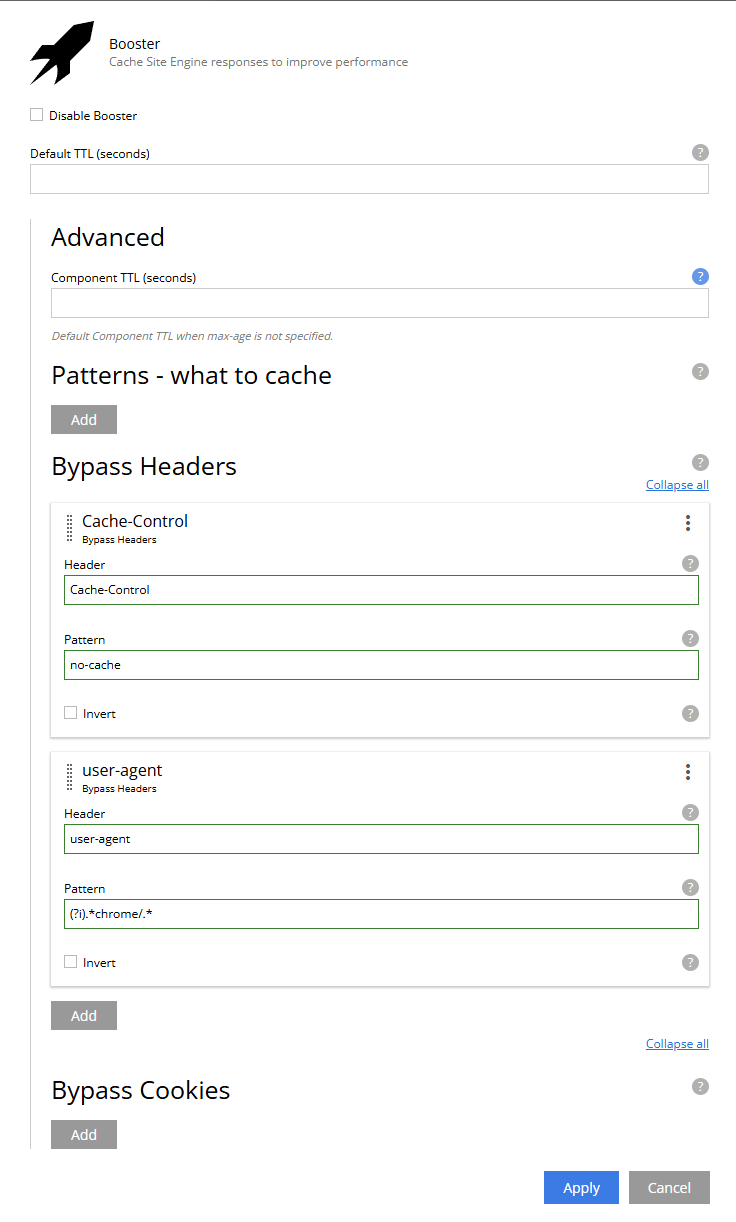
Default TTL
Default TTL setting allows to specify cache TTL for controller responses without max-age or s-max-age headers. By default, the value is not set and the cache TTL is determined by the cacheTtl configuration property.
Advanced settings
Component TTL
Component TTL setting to specify cache TTL for component controller responses without max-age or s-max-age headers. If not specified Default TTL is used.
URL Patterns
By default, Booster caches all regular paths within a site. Cache Patterns let you limit caching to some paths only, or exclude some paths from caching.
The rules are:
-
If the list is empty, all paths are cached.
-
If the list contains one or more patterns, a request is cached only when at least one pattern accepts its path. Paths that are not accepted by any pattern are not cached.
-
A pattern without
Invertaccepts the paths that match the regular expression. -
A pattern with
Invertaccepts the paths that do not match the regular expression.
In other words, the list is a single "cache this" list where the patterns are combined with OR. There is no separate exclude list: an exclusion is written as one inverted pattern, or as a part of the regular expression itself. See the examples below.
A pattern is a Java regular expression with the same syntax as XP Framework pattern mappings. Keep the following in mind when writing one:
-
The pattern is matched against the content path relative to the site, starting with
/. For a site at/mysite, the content/mysite/blog/my-postis matched as/blog/my-post, and the site itself is matched as/. Virtual host mappings do not affect the path. -
The pattern must match the whole path, not just a part of it.
/blogmatches only the/blogpage itself. To match a page and everything below it, use/blog(/.*)?. -
Matching is case-sensitive.
-
Query parameters are ignored, unless the pattern contains an escaped question mark (
\?). In that case the pattern is matched against the path followed by?and the normalized query string (parameters sorted by name, excluded parameters removed), for example/search?page=2&q=enonic. The?is present even when the request has no query parameters.
Examples
Pattern: /api(/.*)?
Invert:  checked
/api and everything below it is not cached. All other paths are cached.
Pattern: /(api|search|account)(/.*)?
Invert:  checked
List all exclusions in one inverted pattern, separated with |.
Do not add a separate inverted pattern for each exclusion. Since it is enough that one pattern accepts the path, two inverted patterns /api(/.)? and /search(/.)? cancel each other out: /api is accepted by the second pattern, /search is accepted by the first one, and as a result everything is cached. |
Pattern: /blog(/.*)?
Invert:  unchecked

Pattern: /docs(/.*)?
Invert:  unchecked
Only /blog, /docs and everything below them is cached. Nothing else is cached, including the site front page.
Pattern: /
Invert:  unchecked
Pattern: /blog(/(?!drafts(/|$)).*)?
Invert:  unchecked
/blog and everything below it is cached, except /blog/drafts and everything below it. Nothing outside /blog is cached.
Do not combine a regular pattern with an inverted one for this purpose. The patterns /blog(/.)? and inverted /blog/drafts(/.)? together cache the whole site: the inverted pattern accepts every path outside /blog/drafts, and /blog/drafts itself is accepted by the first pattern. Put the exclusion inside the regular expression using a negative lookahead (?!…), as shown above. |
Pattern: /search\?.+
Invert:  checked
/search?q=enonic is not cached. /search without query parameters and all other paths are cached.
| The patterns only decide if a response may be stored in the cache. All the other conditions described in How it works still apply. |
Bypass Headers and Cookies
Bypass Headers and Cookies let you define rules that prevent requests from being served from cache, and also ensure that matching responses are not stored in cache.
You can specify one or more header or cookie rules. Each rule consists a name and Java Regular Expression pattern. An invert attribute can be used to indicate that the result of evaluating the regular expression should be negated.
If any incoming request header or cookie matches a rule, the request will bypass the cache entirely.