Juke AI
Contents
Juke AI assists editors with writing and translating content in the Content Editor. It provides two skills:
-
Content Operator — a chat interface for generating, revising, and comparing suggestions for form fields.
-
AI Translator — translates supported text when localizing content or changing its language.
| Content Studio+ feature. Juke AI requires a valid Content Studio+ subscription and the application for each skill that editors will use. |
Review generated and translated values before saving or publishing. AI suggestions can contain mistakes, and inserting them does not replace the normal content workflow.
Content Operator
The Juke AI Content Operator application provides the chat interface. It works with the current content’s form and returns suggestions that can be inserted into individual fields.
Open the chat
Click the Juke icon in the Content Editor toolbar to open or close the chat.

Enter a prompt at the bottom of the dialog and use the send arrow to submit it. Juke’s responses appear in the conversation, where you can ask follow-up questions or refine the instructions.
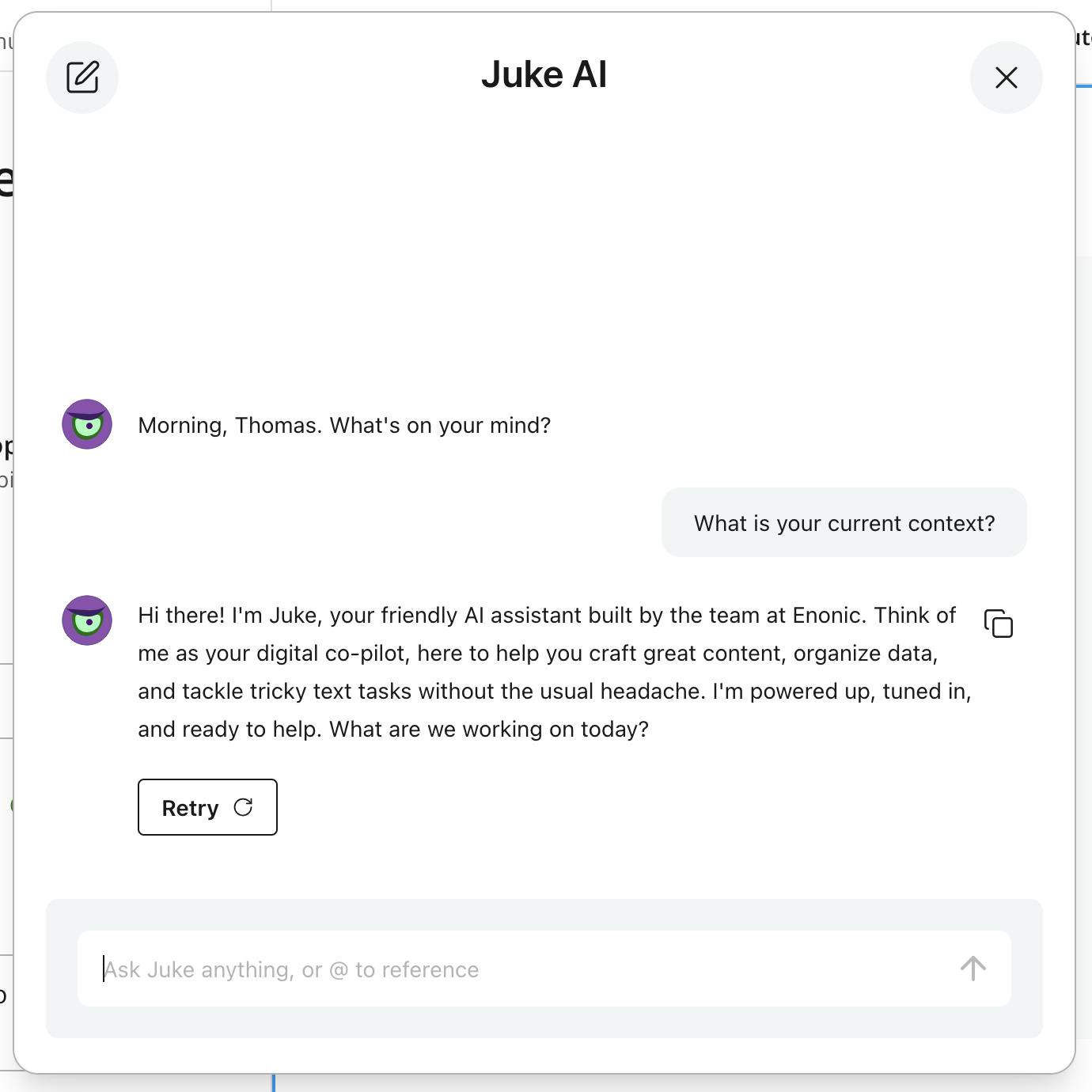
Use New chat, the icon in the upper-left corner, to clear the conversation and its field context. Starting a new chat does not undo values already inserted into the form.
Field mentions
Type @ in the prompt to open the field picker, then select a field. This inserts a field mention: a reference to that form field and its value. You can mention several fields in the same prompt, for example to generate a display name from the body text or revise a title and teaser together.
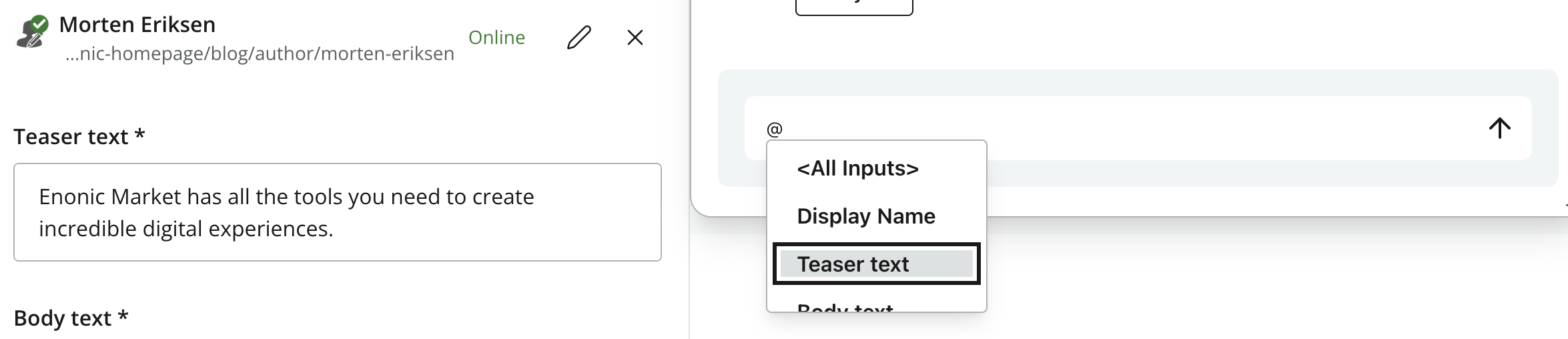
The All Inputs choice references all available fields in the current scope. A field mention appears as a labeled token in the prompt; select it from the picker so Juke receives the field reference.
Example prompts using field mentions:
-
Improve
@Display Nameand@Teaser text. -
Write a shorter
@Teaser textbased on@Body text. -
Turn the list in
@Body textinto a numbered list.
Field context
Field context narrows the conversation to a particular part of the form. The selected field’s label appears above the prompt, such as Body text. When a field context is active, the mention picker offers fields within that scope. Use Clear context beside the field label to return to the form’s root-level fields.
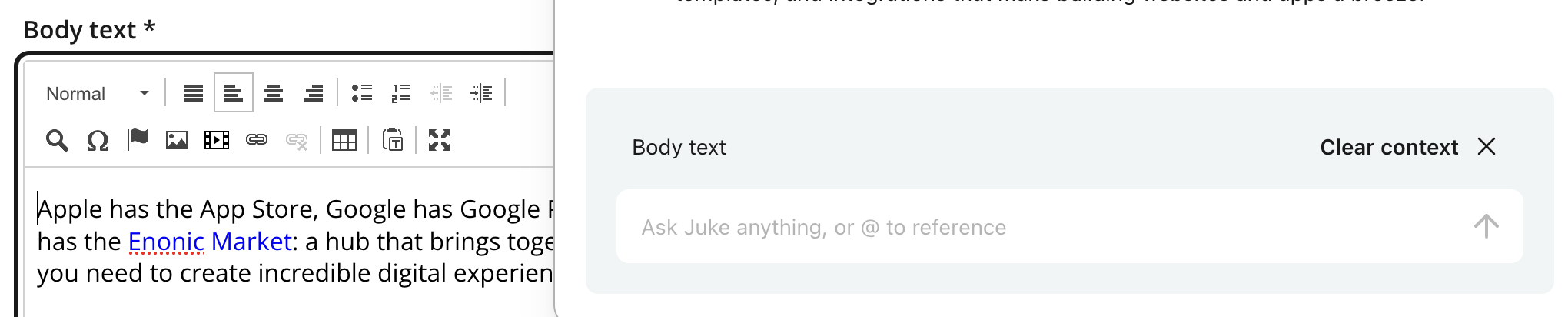
Field mentions let you identify the inputs to use in an individual prompt. The available fields depend on the current form and context; see Scope and limitations.
Suggestions and insertion
Juke can return a general response or suggestions associated with named fields. Field suggestions show the target field’s label above the proposed value.
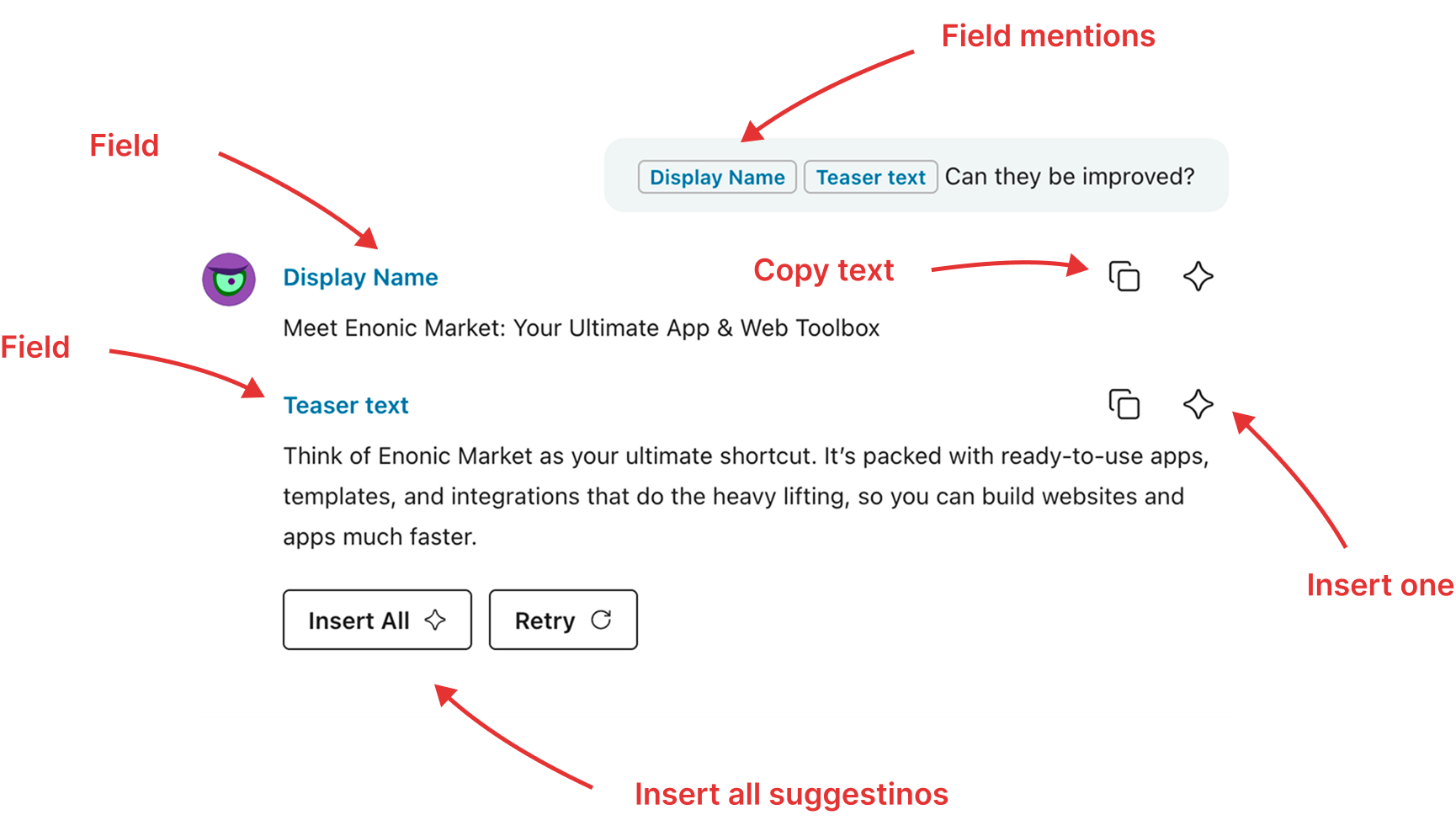
Each field suggestion provides these controls:
-
Insert — the sparkle icon replaces the corresponding form value with the suggestion.
-
Copy — the overlapping-squares icon copies the suggestion to the clipboard for manual use.
Use Insert All to insert the response’s field suggestions together. A general response can be copied, but has no target field for insertion.
Inserted values update the open form. Review them and use the normal Save and publishing actions to keep or publish the changes.
Retry
Use Retry beneath the latest response to generate another response to the same prompt. To change the instructions, send a follow-up prompt instead. A new response does not replace form values until you insert it.
Alternatives
Ask for multiple alternatives when you want to compare suggestions for a field, for example: Make 3 alternatives for @Teaser text.
Use the arrows beside the field label to browse the alternatives. The counter, such as 1/3, identifies the currently selected suggestion. Insert uses that suggestion; Insert All uses the selected alternative for each field in the response.
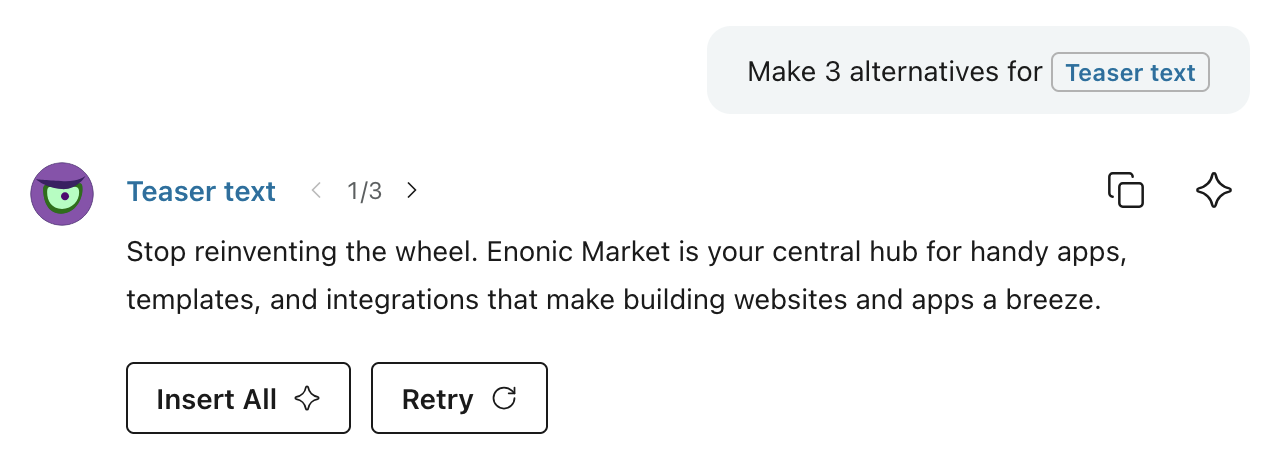
These alternatives exist in the chat. They do not create content copies or content variants.
General instructions
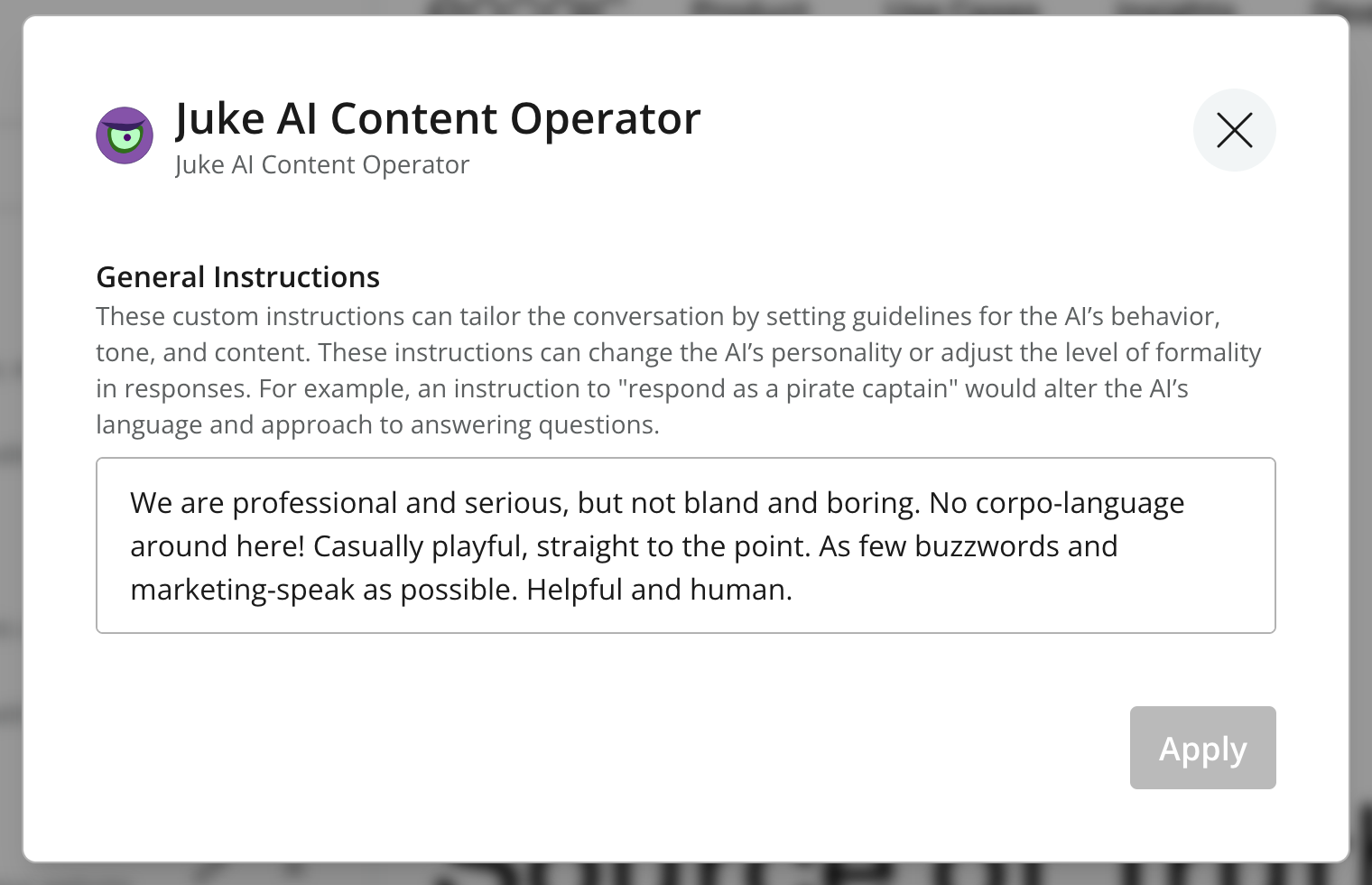
Configure General Instructions on the Content Operator application to give Juke guidance that applies across conversations. This can describe the intended audience, tone of voice, preferred terminology, or writing style. Editors can give more specific instructions in individual prompts.
Scope and limitations
The Content Operator works in the Content Editor with the display name and supported text fields, including TextLine, TextArea, and HtmlArea inputs. Use the field picker to see which fields are available in the current context.
The chat currently does not support fields in mixins or pages. Support for these fields is planned for an upcoming release.
Suggestions are intended for content authoring. They do not perform content actions such as publishing, moving, or deleting items. The AI Translator has its own dialog and is not invoked through the Content Operator chat.
AI Translator
The Juke AI Content Translator application translates content into the item’s target language. When enabled, it opens the AI Automated Translation dialog after an editor localizes an inherited item or changes an item’s language.
Translate content
The dialog identifies the target language and automatically copies the Translator application’s General Instructions into Translation instructions. Use this standard prompt as provided, or adjust it for the current item before clicking Translate. Instructions can specify terminology, tone, words to avoid, or names and phrases that must remain unchanged.
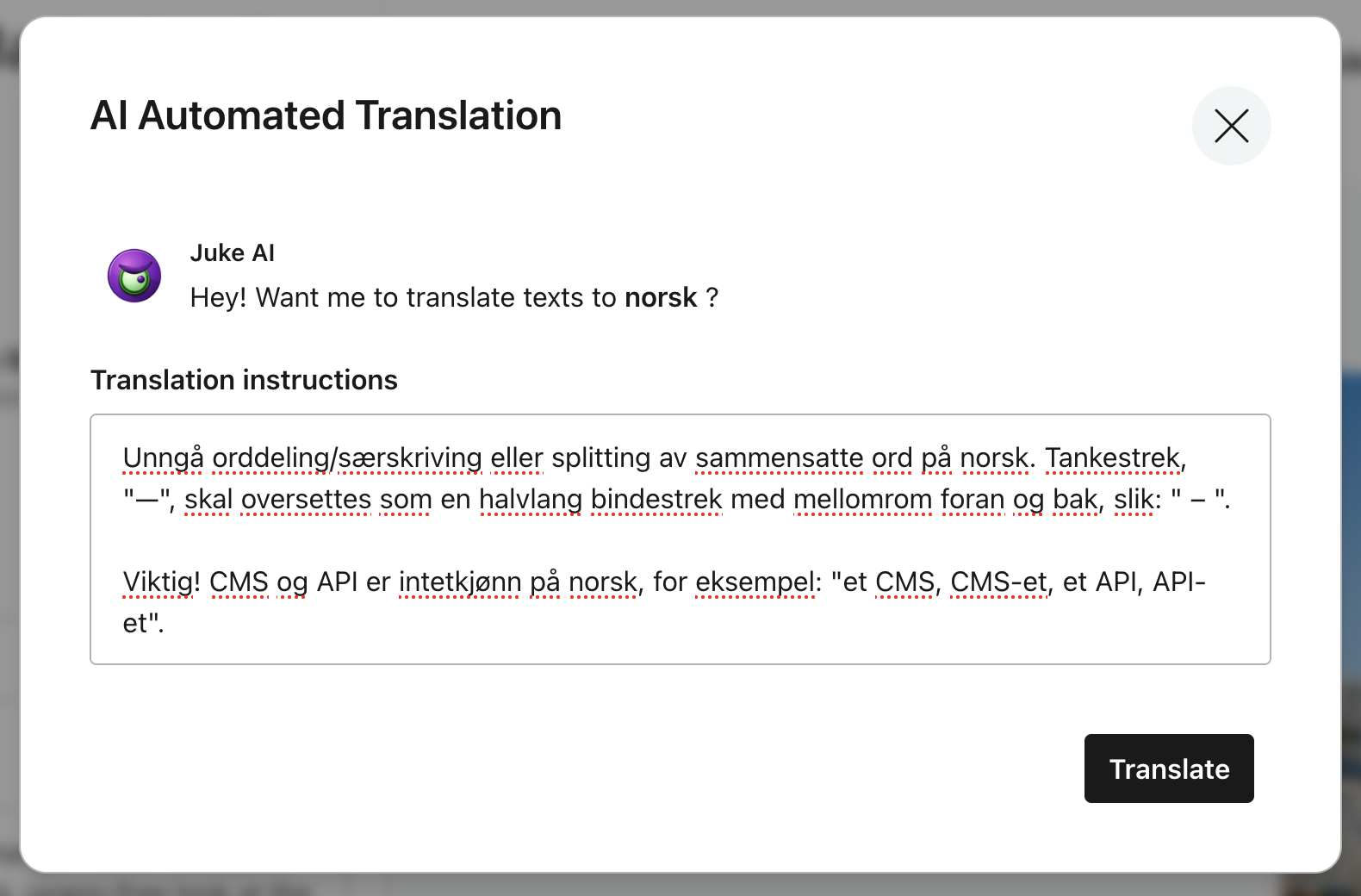
Translation progress is reported for each value, and successful results are inserted into the open form. Close the dialog when translation finishes, review the results, and save the content. Publishing remains a separate action; see Publish.
The Translator handles the display name and supported text inputs, including TextLine, TextArea, and HtmlArea fields. Text in supported X-data and page components can also be translated when their schemas are available. Non-text values and unsupported inputs are left unchanged.
| The Localize action stops the item’s Content inheritance before the Translator opens. Translation does not change name, parent, or sort inheritance. See Content inheritance. |
Translation instructions
Configure General Instructions on the Translator application to provide reusable translation guidance, such as a glossary or language-specific writing conventions. The Translator has its own instructions, separate from the Content Operator’s.
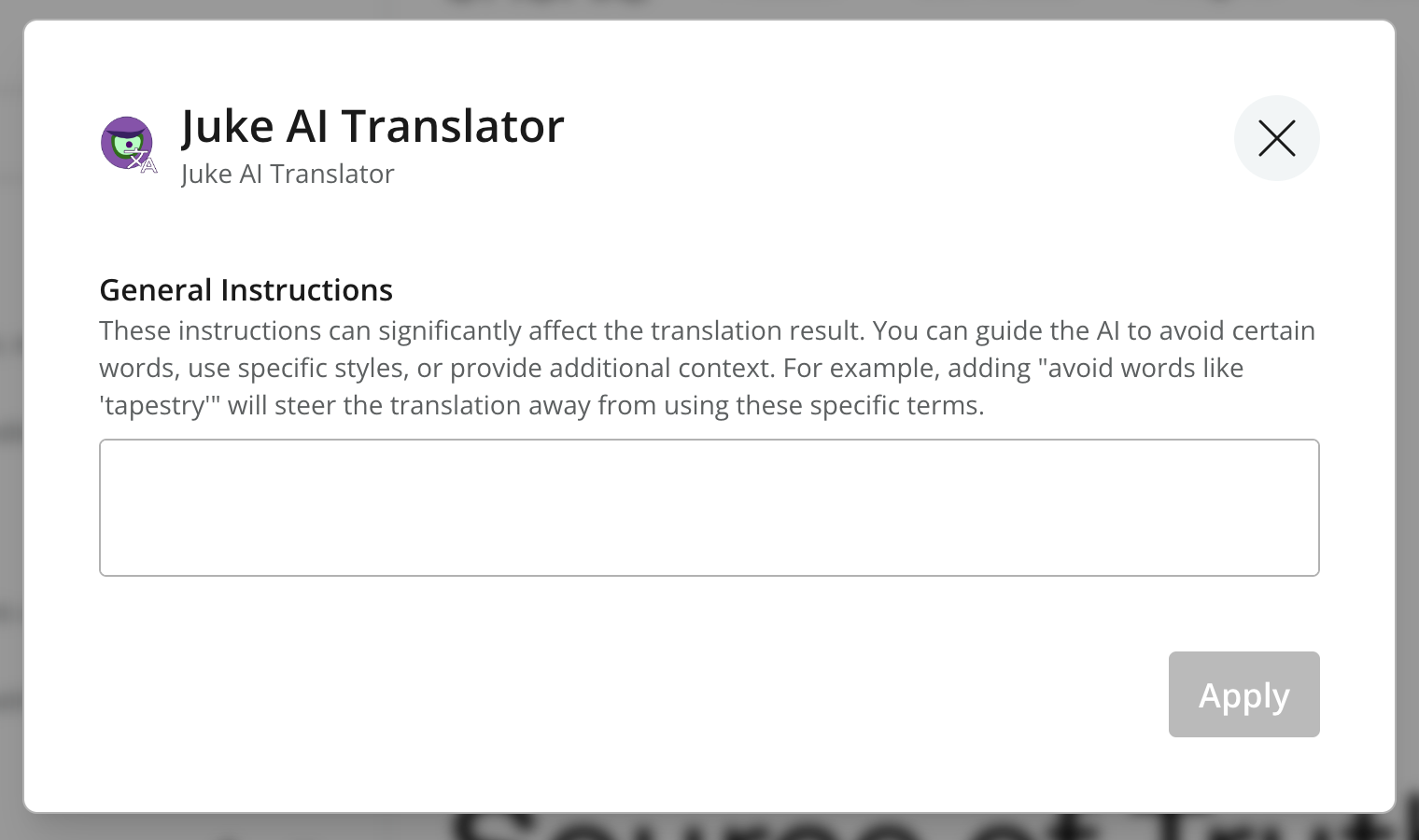
Configure the application at the relevant project or Site scope. Changing application settings requires the Owner project role or an administrator role.
These instructions are automatically copied into the translation dialog for each item. Editors can use the standard prompt unchanged or adjust Translation instructions for that item. Edits in the dialog do not change the application’s configured instructions.